
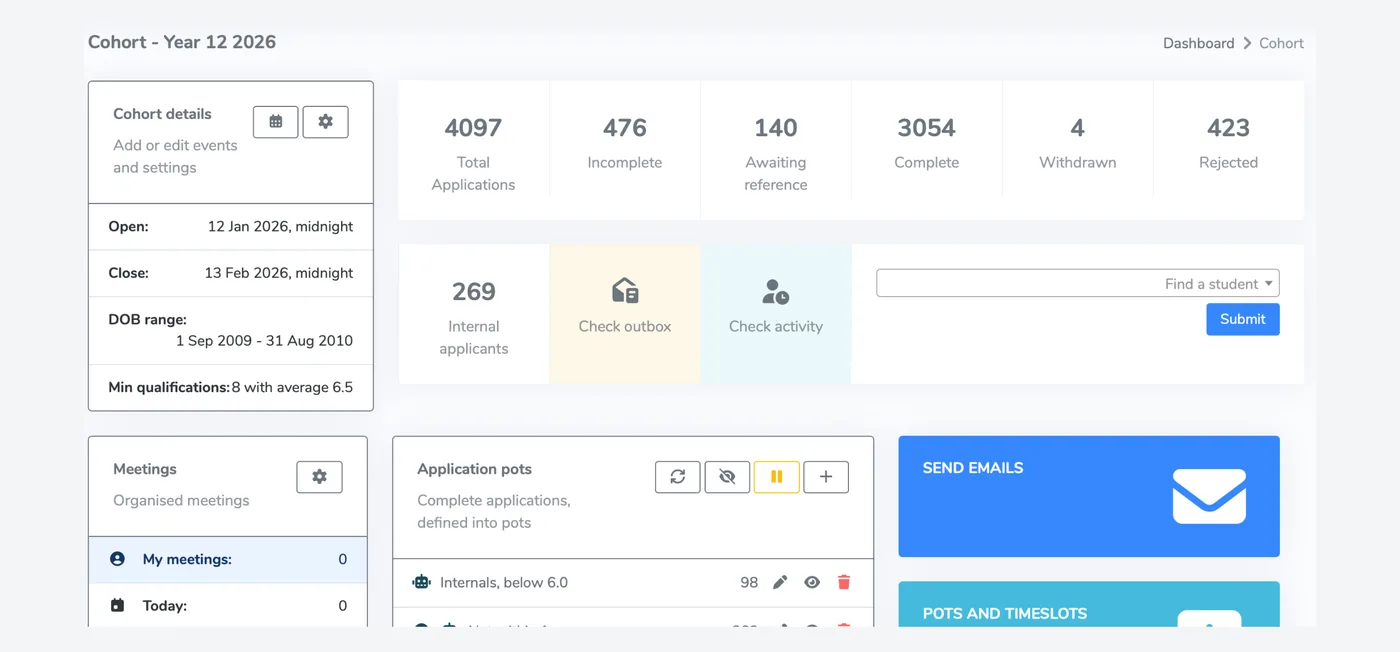
Sixth form admissions is a twelve-month cycle that most schools run as a series of surprises. The open evening is suddenly next week, the application deadline has passed and nobody has looked at the references, results day is in August and the time slots were never set up. The cycle is the same every year. This guide lays it out month by month for a state sixth form in England, with the decisions that belong in each month, so that the surprises can be scheduled.
September: set the rules for the year after next
The cohort that enrolled last month is done. The cohort applying this year needs its rules before the open evening, which is usually in October. That means September is when the subject list, entry requirements, class caps and pathways are agreed, and when last year's settings are copied forward and edited rather than rebuilt. It is also the month to collect last year's numbers: applications per subject, taster day attendance, conversion from offer to enrolment. Those numbers decide the caps.
October: open evening and the application opens
The application should open the week of the open evening, while interest is highest, and the link should be on every slide and every leaflet. Students who apply on the night are more likely to enrol than students who take the leaflet home. Make the form work on a phone, because that is what they will have in the hall.
Decide the closing date now and publish it. December or January is usual. A closing date that is announced in October is enforceable; one announced in December is not.
November to December: applications arrive, references go out
Each application should trigger a reference request to the student's current school the day it is submitted, with reminders that run themselves. By December the admissions officer's job is to watch a list, not to send emails: applications with bounced reference requests need a corrected address, applications with a missing UPN or an impossible date of birth need a correction, and everyone else needs nothing.
This is also when the taster day structure should be sketched, because it depends on the subject choices coming in. If 120 students have chosen psychology, the taster day needs four psychology classes, and that needs rooms and teachers booked in the spring timetable.
January: closing date and admissions meetings
After the closing date, meet the applicants. Whether that is a formal interview or a ten-minute conversation, the point is the same: confirm the subject choices against the predicted grades, raise any gap, and make the student feel that they have a place to come to. Book the meetings in blocks, send the invitations from the system, and let students accept or reschedule themselves, because a hundred individual emails about Tuesday at 3.40 is a fortnight nobody has.
Applications that arrive after the deadline are a policy question. Decide in advance whether they go on a waiting list, are accepted while subjects have room, or are declined, and apply the same answer to everyone.
February to March: offers and the taster day grid
Conditional offers go out, stating the pathway requirement and the subject requirements in the same words the results day desk will use. The taster day grid is finalised: subjects, slots, classes, sizes. If allocation is automated, run it now and look at the clashes while there is time to add a class.
April to May: deposits, taster days, and the quiet period
Some sixth forms ask for a registration fee or a deposit at this point, refundable on enrolment, as a signal of intent. If so, request it from the system so that it is reconciled against the student and waived with a reason where a bursary applies. Taster days usually run in late June or early July, but the invitations and timetables go out now.
This is also the quietest stretch of the cycle and the right time to review the results day plan from last August: what queued, what was overridden, what the rules did not answer. Fix the rules while there is time.
June to July: taster days and the results day setup
Run the taster days with attendance recorded at the door, and add the attendance to each applicant's record. Then set up results day: time slots, the staff rota for the three streams of confirmations, borderline cases and subject changes, and the route by which grades will arrive. If students are to share their DfE Education Record, the provider registration should already be done and the message to students should go out before the end of term, while they still read school emails.
Confirm every applicant's subject choices one last time in July. Choices made in November have often changed.
August: results day and enrolment
GCSE results day is the Thursday in the third week of August. Students submit or share grades, the rules are applied as grades arrive, confirmations go through the fast stream, borderline cases go to the people who can decide, and every decision and override is recorded with a name and a reason. Confirmation emails go out as places are confirmed. The enrolment report at the end of the day shows the cohort against the caps.
The following week is for the waiting lists, the late applicants, and the export to the MIS. Then the cycle starts again, and the first job of September is to look at the numbers.
The same record, all year
What makes the cycle manageable is not any single step but the fact that each one feeds the next. The application carries the subject choices that drive the taster day grid and the results day check; the reference carries the predicted grades that shape the interview; the taster day attendance sits next to the results day decision. When those live in one record from October to August, the admissions officer runs a process. When they live in five spreadsheets, they run a search.
P16 was built to hold that one record, from first application to enrolled student. The features page walks through each stage in the order above.