
Most sixth form entry requirements are written for a prospectus: "five GCSEs at grade 5 or above, including English and maths, and a grade 6 in the subject you wish to study." That sentence is fine for a parent. It is not fine for the person at the results day desk, because it leaves out everything that gets asked at 9.15am. Does combined science count for physics? Is it a 6 in English language or English literature? What happens to the student with four 5s and a 4?
This guide walks through turning a prospectus sentence into a set of rules that can be applied the same way by every member of staff, or by software, using a worked example from a typical three A level pathway.
Start with the pathway, not the subject
A requirement has two layers. The pathway sets the overall bar: how many GCSEs, at what grade, and which subjects are compulsory. The subject sets the bar for each course on top of that. Write the pathway first, because it decides who is in the room at all.
A worked pathway for three A levels:
- At least five GCSEs at grade 5 or above.
- Grade 5 or above in English language or English literature.
- Grade 5 or above in mathematics.
Every word there is a decision. "At least five" means a sixth GCSE at grade 3 does not count against the student. "English language or English literature" settles the most common question on the desk. If the sixth form also runs a vocational pathway with a lower bar, write that as its own list rather than as exceptions to this one.
Then one line per subject
Each A level gets a requirement in the same shape: the minimum grade, the GCSE it is measured in, and the fallback if the student did not take that GCSE. Three examples:
| A level | Requirement | Fallback |
|---|---|---|
| Mathematics | Grade 7 in GCSE mathematics | None |
| Physics | Grade 6 in GCSE physics and grade 6 in mathematics | Grade 6-6 in combined science counts in place of physics |
| Psychology | Grade 6 in a science GCSE and grade 5 in English | Grade 5-5 in combined science counts as a science at grade 5, not 6 |
The fallback column is the one that saves time on the day. Half of the queries at a results desk are from students who took combined science, or who took a GCSE in a related subject the requirement does not name. If the answer is written down, a member of support staff can give it. If it is not, the student waits for the head of physics.
Decide the class cap in the same breath
A requirement says who is eligible. A cap says how many of them can have a place. Set the cap per subject when you set the requirement, and decide what happens when it is reached: a waiting list in order of application date, in order of grade, or at a head of department's discretion. Any of those is defensible. Not having decided is not.
Write down who can override, and how
Rules exist so that most students do not need a judgement. Some will. A student one grade short in one subject, with strong grades everywhere else, is a judgement call, and the question is who makes it. A workable split:
- A head of department can admit a student who misses the subject requirement by one grade, if the class has room.
- Only the head of sixth form can admit a student who misses the pathway requirement.
- Every override is recorded with the name of the person who made it and a one-line reason.
The record matters more than the rule. In September a parent will ask why one student was admitted and another was not, and "the head of chemistry admitted them on the strength of a 6 in physics, recorded at 10.14 on results day" is an answer. "I think it was discussed" is not.
Test the rules before August
Take last year's results and run every student through the new rules on paper or in a spreadsheet. Count how many are admitted to each subject, how many land in the waiting list, and how many produce a question the rules do not answer. The third number is the one to drive to zero. If a rule generates the same question ten times, the rule is missing a line.
This is also the point to check the rules against the prospectus and the website. A requirement that is stricter than the published one is a complaint waiting to happen. Change the publication or change the rule, but make them match.
Keep the rules where the decisions are made
The best written rules in the country do no good in a folder on the shared drive. On results day they need to be on the screen the desk is looking at, applied to the grades in front of them. In practice that means the rules live in whatever system records the grades, so the check happens the moment the grades go in and the desk sees the outcome rather than working it out.
How P16 holds the rules
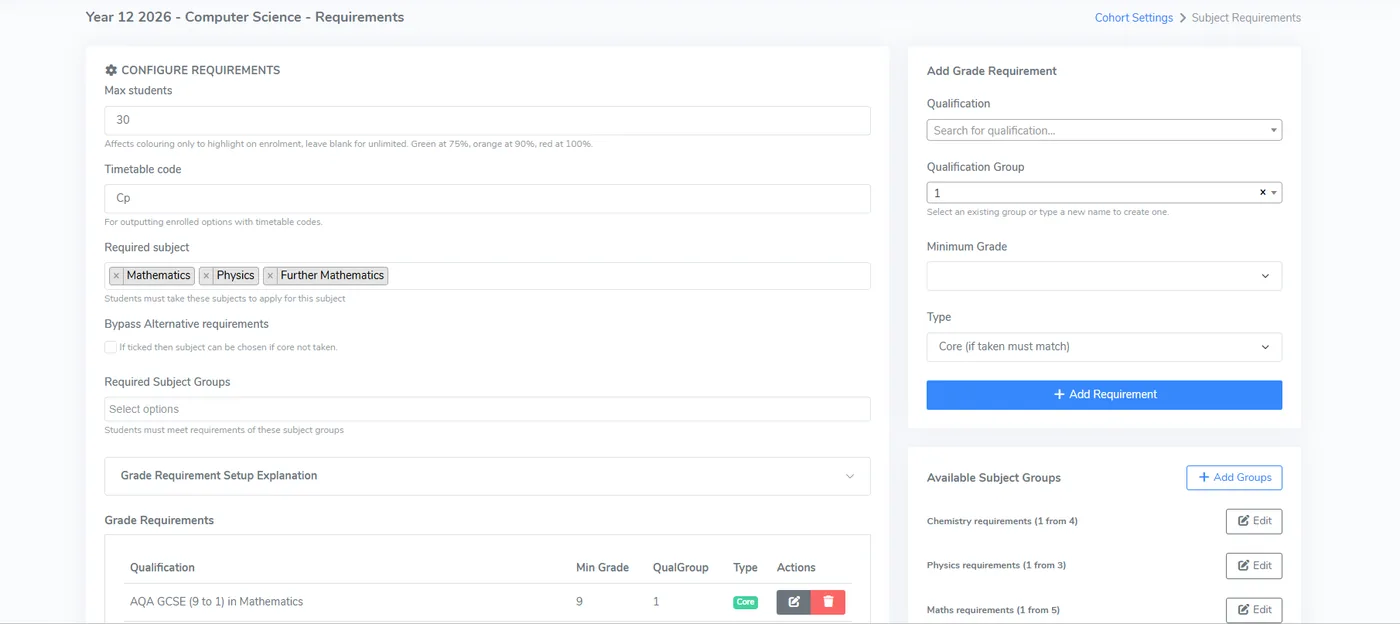
In P16 every subject carries its own minimum grades, required GCSEs and class cap, and pathways set the overall bar. The rules are applied as a student chooses subjects in their application, so an applicant who does not meet a requirement is placed on a waiting list rather than silently accepted, and again on results day as grades arrive, whether they come from the student, from staff or from the DfE's Education Record. Overrides are recorded with the staff member and reason, and last year's subject list and requirements can be copied into the new cohort in one step. The applications page shows the requirements screen.